
Engineering Preservation: Technical Handling Protocols for Archival White Label Journals
Technical B2B guidelines for handling and preserving white label journals.
by Aika Mentari · February 9, 2026
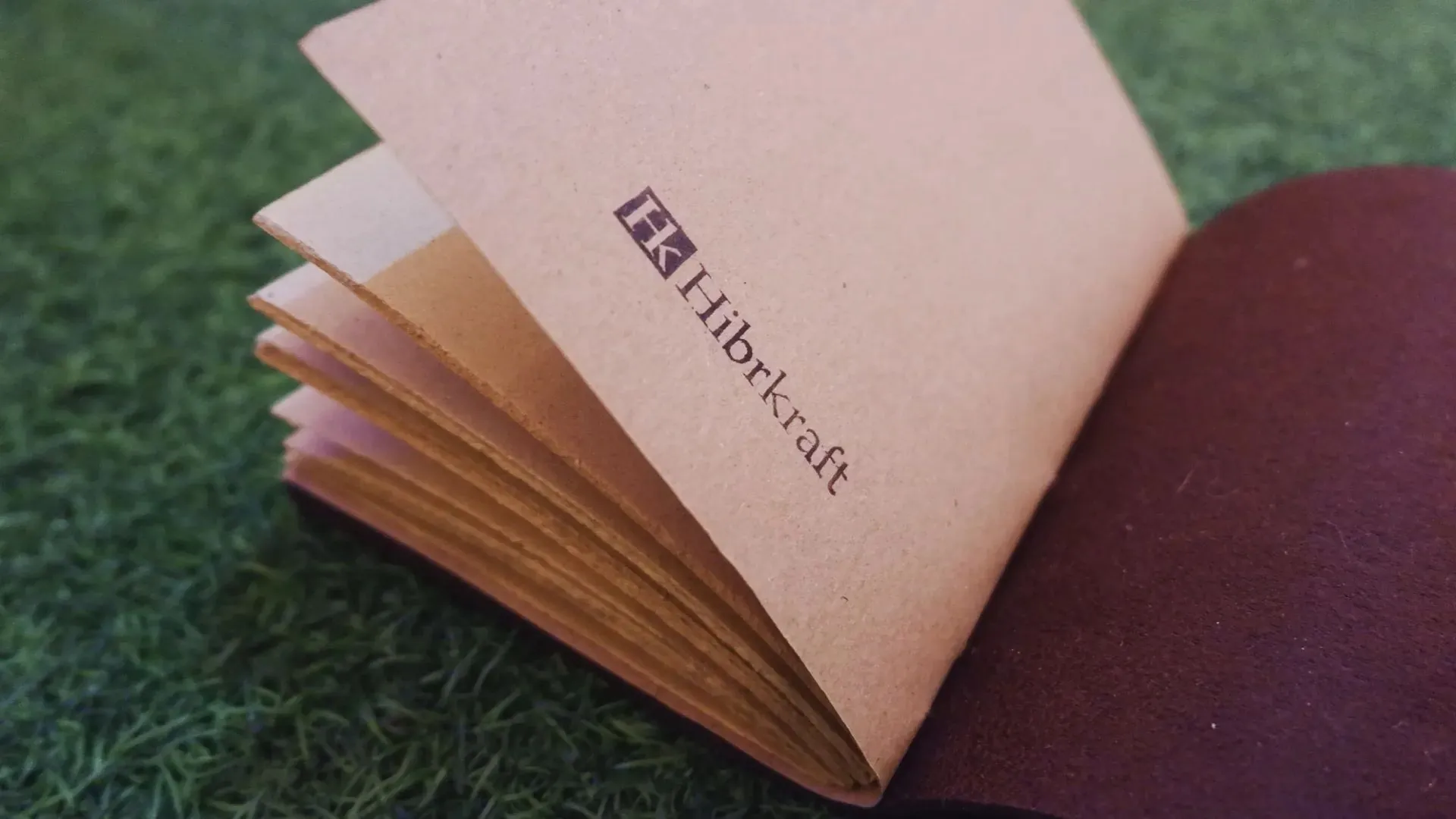
In our Cileungsi workshop, there is a moment of quiet finality when a journal is completed. The last stitch is knotted, the edges are burnished, and the leather is conditioned. Before it is wrapped, one of our craftsmen will perform the final inspection. They open the book to the first page, just as you see in the image above. It is a pristine, untouched surface, bearing our mark of quality. This moment is the culmination of hours of focused labor. The fibrous texture of the kraft paper is perfect, the rich, dark suede of the leather cover is immaculate. This is the state in which we expect the product to reach your client. But from this moment forward, the journal enters a new phase of its life—one defined by touch.
Every hand that holds this journal will leave an invisible trace. Every fingerprint deposits a microscopic layer of oil, salt, and acid. To a mass-produced, plastic-coated notebook, this is meaningless. But to an organic, breathing object made of cellulose and collagen, it is a chemical event. The image—a Hibrkraft journal poised on a bed of green—serves as a metaphor: a natural object must be carefully managed, even in a controlled environment. The promise of archival longevity is not just sealed in the binding; it is preserved or destroyed by every subsequent touch.
When you invest in a white label order from Hibrkraft, you are investing in a tactile experience. We do not just teach you how to sell it; we teach you how to be its first, and best, custodian.
From a material engineering perspective, the longevity of a custom leather journal is as dependent on user handling protocols as it is on initial substrate quality. A journal built with the finest acid-free paper from Paperina and wrapped in premium Full Grain leather from a Magelang tannery can be chemically compromised within weeks by improper handling. The fundamental principle is one of contamination control. The archival environment we strive to create within the journal’s pages is a delicate chemical balance that is easily disrupted.
To maintain the chemical purity of pH-neutral and archival-grade papers, it is a technical requirement to handle materials with strictly clean, dry hands or, ideally, professional-grade nitrile or cotton gloves. This is not theatrical; it is pure chemistry. Human skin is a complex organ that secretes sebum, a mixture of oils including triglycerides and fatty acids, as well as perspiration, which contains salts (sodium chloride) and other acidic compounds. When you press a thumb to a page, you are stamping it with a chemical cocktail. These acids catalyze “acid hydrolysis,” the process where water molecules break down the long polymer chains of cellulose that give paper its strength. Over time, that innocent fingerprint will reappear as a permanent, yellow-brown stain—a process often mistaken for “foxing.”
For high-value documentation, such as limited-edition signed copies or journals intended for long-term corporate archives, material strategy suggests using secondary tools such as archival-grade bone folders or spatulas to lift and turn pages. This eliminates direct human contact and the risk of surface contamination entirely. In the context of a B2B order, this means training your warehouse and fulfillment staff. The person picking and packing a 500-unit order for a corporate client must understand they are handling a sensitive organic material, not an inert plastic widget.
| Handling Action | Archival Standard (Hibrkraft Recommended) | Common Negligent Practice | Long-Term Material Consequence |
|---|---|---|---|
| Touching Pages | Clean, dry hands or cotton gloves. | Unwashed hands (food/lotion residue). | Yellow/brown staining, localized acid migration. |
| Marking a Page | Acid-free paper bookmark. | Folding a corner (“dog-earring”), metal clip. | Permanent crease, fiber breakage, rust stains. |
| Adding an Insert | Lignin-free, buffered marketing card. | Standard glossy business card or acidic flyer. | Acidic “shadow” burned into adjacent pages. |
| Carrying | Supported from beneath with both hands. | Held by one cover, allowing it to hang. | Stress on spine joint, loosening of binding. |
The protocols outlined above are not just for museum curators; they are for any brand that wants its physical products to reflect its commitment to quality. When a client receives a corporate gift with a greasy thumbprint on the first page, the perceived value of the gift—and by extension, the giver’s brand—plummets.

The Banned List: Mechanical and Chemical Sabotage
The structural integrity of the internal paper block is further compromised by the use of standard office fasteners. Procurement managers must mandate the absolute avoidance of adhesive tapes, metal clips, and rubber bands in any system involving archival journals. These are not tools; they are agents of destruction.
1. Adhesive Tapes: Standard office tape is a chemical nightmare for archival materials. The adhesive is often an unstable synthetic polymer on an acidic plastic carrier. Over time, the adhesive breaks down, oozing a sticky, yellow substance that leaches into the paper matrix. It causes irreversible discoloration and makes the paper translucent and brittle. Attempting to remove old tape almost always results in tearing the paper surface. There is no safe way to use it.
2. Metal Clips: A simple paperclip introduces two distinct failure vectors. First is mechanical damage. The clip exerts high point pressure on the paper fibers, crushing and weakening them. Over time, this creates a permanent indentation and can easily lead to tearing. Second, and more insidious, is chemical damage. Even “stainless” steel can corrode in a humid environment (like our home in Bogor). This corrosion is rust (iron oxide), which is acidic. It leaves a deep orange stain that permanently bonds with the cellulose fibers.
3. Rubber Bands: These are perhaps the most destructive office supply item when it comes to long-term storage. Rubber bands are made from latex that has been vulcanized with sulfur. As the rubber ages, it perishes. It can become hard and brittle, snapping and leaving cracks in the leather. More commonly, it reverts, becoming a sticky, semi-liquid black tar that melts into the paper and leather. This process also releases the sulfur compounds, which can tarnish metallic foil stamping and cause severe chemical degradation to both the paper and the high-density collagen of the leather cover. A rubber band left on a journal for a year is not a placeholder; it is a chemical weapon.
The Core: Physical Support and The Perils of Gravity
Beyond chemical contamination, we must consider the physics of handling. A book, especially a hand-bound one, is a complex mechanical object. The strength of the binding—whether it is our signature Coptic Stitch or a traditional Case Binding—depends on the even distribution of stress across the spine.
When carrying or displaying a journal, providing rigid physical support is essential. This means carrying it with both hands, supported from the bottom, like a tray. If you hold a journal by one cover and let the text block hang, all of that weight is pulling on a single line of adhesive or a few rows of thread. This places immense torque on the spine joint, which can lead to the text block separating from the cover over time. For display purposes, a book should be supported by a proper cradle or stand that supports both covers and the spine, preventing the warping that can occur if left open to a single page for months.
Furthermore, any internal inserts must be chosen with the same care as the journal itself. If you are a corporate client adding a welcome letter or a marketing card to your white label journals, that insert must be printed on acid-free and lignin-free buffered material. A standard, acidic business card placed inside a journal will act like a chemical time bomb, leaving a perfect, yellowed rectangle on the pages it touches—a ghost of poor planning. This is the principle of preventing cross-contamination.

“The hand that stitches the book must be met with a hand that respects it. Our craft ends at the workbench, but the life of the journal depends on the wisdom of every hand that holds it next.” – Head Craftsman, Hibrkraft
This philosophy is central to our process. Our craftsmen in Bogor work with clean hands and on clean surfaces. We understand the responsibility of delivering a chemically pure product. When we pack a bulk order, we are sealing that purity into the box. But once that seal is broken, the responsibility transfers to you.
Imagine the scenario: You deliver 500 custom-branded journals for a company’s new-hire orientation. The HR team, in a rush, uses rubber bands to attach a welcome letter to each one. The journals sit in a warm office for a week before the event. On orientation day, as the new hires remove the letters, the rubber bands are already sticky, leaving a tacky residue on the premium leather cover you paid for. The first impression of your client’s brand is literally a sticky mess. This is not a failure of the product; it is a failure of handling protocol.
The Solution: A Culture of Preservation
By implementing these rigorous handling standards, corporate organizations ensure that their white label journals serve as permanent archival assets rather than deteriorating commodities. The solution is not just about buying gloves; it is about creating a culture of preservation around the product. It is about educating your team that they are handling a premium, organic object that requires a different level of care than a plastic pen.
The Return on Investment (ROI) is measured in brand perception. A pristine, immaculate journal communicates attention to detail, quality, and respect for the recipient. A damaged, stained, or dog-eared one communicates the opposite. By enforcing these protocols, you eliminate the risk of “unforced errors” that can tarnish your brand’s image and lead to costly replacements or client dissatisfaction.
Hibrkraft’s replacement policy is clear: we stand behind our craftsmanship 100%. If there is a defect in the stitching, the binding, or the materials upon arrival, we will replace it. However, this policy cannot cover damage incurred post-delivery due to improper handling, storage, or the use of destructive materials like rubber bands and tape. We are transparent about this because we want to empower you with the knowledge to protect your investment for decades to come.

Why Partner with Hibrkraft?
At Hibrkraft, we are not just a manufacturer; we are your technical partner in preservation. Located in Cileungsi, Bogor, our small team of ~9 craftsmen has a monthly capacity of up to 2,000 units, perfectly blending artisanal skill with the volume needed for B2B and white label fulfillment. We live and breathe the materials we work with, from the finest Indonesian leathers to a range of high-quality papers.
Our White Label service is a collaboration. We put your brand on our craft, and we provide you with the knowledge to ensure that craft endures. We have experience shipping globally via DHL Express to discerning clients in Germany, the Netherlands, Canada, and the UAE. We understand the rigors of transit and the importance of delivering a perfect product.
When you partner with us, you are not just ordering a product. You are gaining access to a deep well of knowledge about leatherworking, bookbinding, and the science of archival preservation. Let us help you build a brand asset that lasts.
Ready to start? Message us on WhatsApp at +62 815 1119 0336 to discuss your bulk order and our handling protocols. Click here to chat.
Sources & References
- Berisford, K. M. (2024). Acid-Free vs Archival: What You Need to Know About Paper Quality for Your Art.
- Chiles, J. (2024). What Is Pull Up Leather? – An In-Depth Look.
- SWITCH-Asia. (2021). Best Practice Guide for Sustainable Vegetable-Tanned Yak Leather Manufacturing.
Disclaimer: this post are written in english to reach more audience.